
Synapse to Fabric DW

Migrate Synapse workloads to Microsoft Fabric Warehouse — without losing behavior, logic, or control.

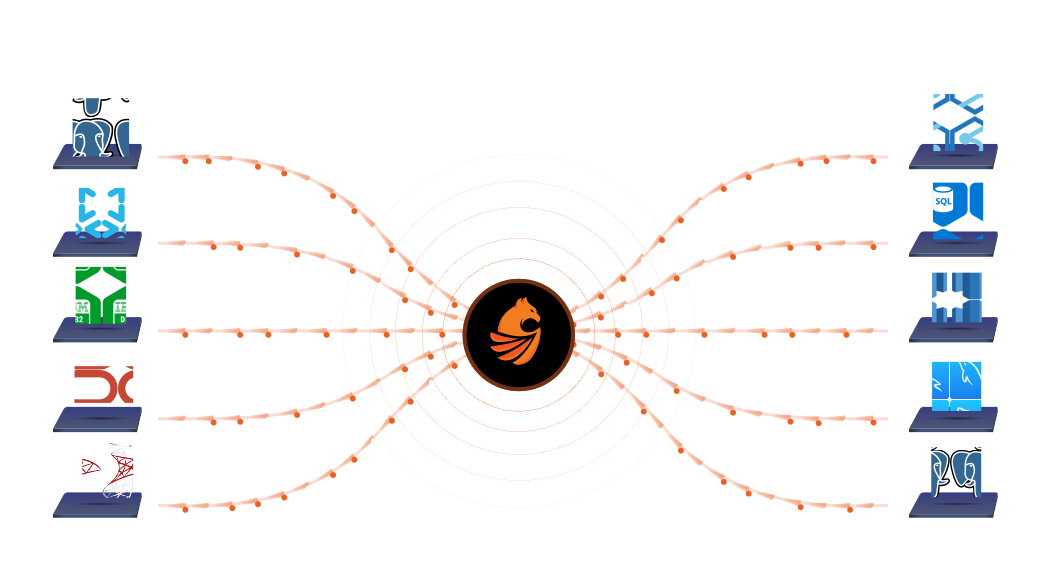
Omni Loader merging many different databases
Lorem ipsum dolor sit amet
At first glance, Azure Synapse and Microsoft Fabric Warehouse look nearly identical

Both are cloud-native analytics platforms. Both use familiar SQL and both target large-scale analytical workloads. However, they are not interchangeable. Fabric Warehouse is not a rebranding of Synapse. It is a managed, opinionated evolution with a different execution model, SQL surface, and feature set.

Key differences that matter in migrations

Graphic representation of Omni Loader's state-of-the-art, modern data migration engine slicing data and operating in a parallel way.

1. SQL surface is not the same

Fabric Warehouse intentionally limits and reshapes supported SQL features. Constructs that work in Synapse may be unsupported, ignored, or behave differently in Fabric.

2. Procedural logic is more constrained

Fabric Warehouse reduces support for procedural patterns, temporary object lifecycles, and control flow assumptions commonly used in Synapse codebases.

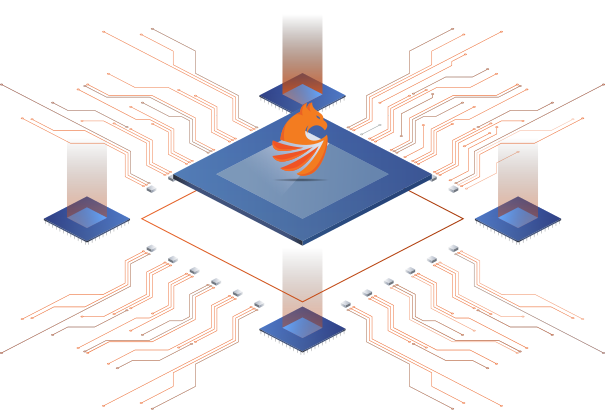
Omni Loader graphically demonstrating its employment of CPUs.
Graphic representation of Omni Loader's state-of-the-art, modern data migration engine slicing data and operating in a parallel way.

3. Execution guarantees have changed

Distributed execution in Fabric introduces different optimization rules and removes some assumptions Synapse users rely on, especially around intermediate results and execution order.

4. “Mostly compatible” is not safe

Even small behavioral differences in analytics pipelines can lead to silent data corruption, incorrect aggregations, or performance regressions.

Omni Loader graphically demonstrating its employment of CPUs.

Manual rewrites introduce regressions, subtle logic changes, and performance surprises. That is exactly where SQL Tran adds value - by detecting differences early, adapting behavior automatically, and making every deviation explicit.

How SQL Tran Bridges the Gap

SQL Tran was designed for complex real-world Synapse codebases. It uses deep static analysis and a targeted emulation and rewrite layer to adapt Synapse SQL semantics to Fabric Warehouse’s execution model, preserving intent while aligning with Fabric’s supported feature set.

Where direct equivalents exist, SQL Tran uses them. Where they don’t, SQL Tran reconstructs behavior using Fabric-native SQL patterns. It transforms Synapse SQL into idiomatic Fabric Warehouse SQL that behaves the same, or flags where exact equivalence is not possible.

screenshot of workspace overview display

What SQL Tran Handles Automatically

SQL Tran parses and analyzes every object, building a complete semantic model:

  • Tables and distributions
  • Views, procedures, and functions
  • Identity logic
  • Temporary and intermediate objects

Nothing is treated in isolation. Dependencies across objects are analyzed and a full code lineage model is built. Broken references, unsupported constructs, and behavioral changes are detected and reported during translation.

graphic icon
Sisyphus

Lorem ipsum dolor sit amet, consectetur adipiscing elit. Mauris imperdiet egestas blandit. Suspendisse rhoncus congue lorem ut malesuada.

Avatar image
Candice Doe
Product Manager, Sisyphus
Lorem ipsum dolor sit amet
Rich Logic & Control Flow
Graphic representation of Omni Loader's state-of-the-art, modern data migration engine slicing data and operating in a parallel way.

Cursors

Fabric Warehouse doesn’t support T-SQL cursors. SQL Tran materializes cursor result sets into temporary tables and rewrites loops into deterministic, row-by-row logic compatible with distributed execution.

Result set limiting

Constructs like SET ROWCOUNT are transformed into equivalent TOP clauses.

Omni Loader graphically demonstrating its employment of CPUs.
Lorem ipsum dolor sit amet
Selected Emulations and Feature Adaptations

SQL Tran includes targeted emulations and rewrites for Synapse-specific behavior when migrating to Fabric Warehouse.

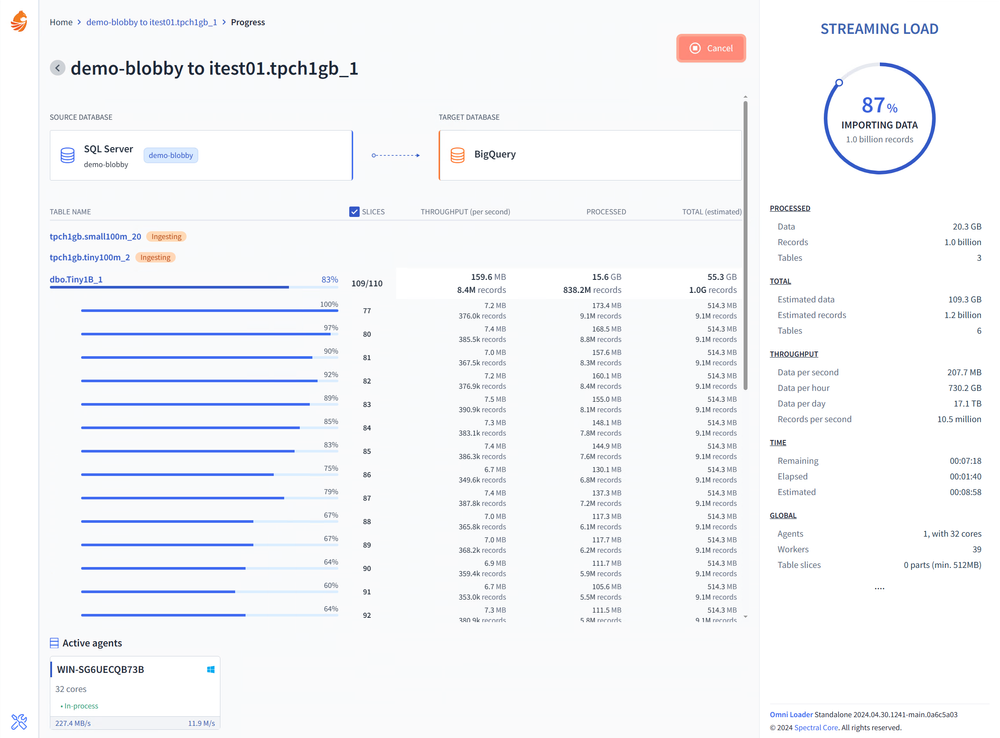
Omni Loader data migration interface showing source and target connection, and streaming load of imported data

Selected Emulations and Feature Adaptations

Database icon representing more than 20 databases
Data types

Synapse data types that differ in support or behavior are rewritten to Fabric Warehouse–compatible equivalents, with explicit handling of precision, collation, and implicit casting differences.

Massive Parallelism icon
Identity columns

Identity behavior is preserved where Fabric supports it and rewritten into explicit value-generation logic where required.

Renaming tables and fields icon representing the extensive mapping rules for customization
Temporary objects

Synapse temporary tables and intermediate constructs are adapted to Fabric-supported alternatives, ensuring predictable lifecycle and scope.

Lorem ipsum dolor sit amet
Translation with Intent

Thanks to super-fast, fully custom parsers, translation of even very large Synapse codebases is practically instant. Millions of lines of SQL can be analyzed and translated in seconds.

SQL Tran does more than rewrite - it aligns Synapse logic with Fabric Warehouse’s execution guarantees, making behavior predictable in production.

Unsupported or Limited Features

Some Synapse constructs cannot be fully preserved and are explicitly flagged:

Unsupported procedural and functional patterns

Platform-specific metadata access

In these cases, SQL Tran preserves structure, annotates limitations, and provides clear guidance for targeted manual review instead of failing silently.

Assessment and Reporting

Assessment is instant and detailed.

SQL Tran generates a complete migration report showing:

  • Detailed database statistics
  • Complexity histogram of objects
  • All detected incompatibilities
  • Deep statistics on object coverage and translation quality

This assessment is produced by running a full translation upfront, exposing exactly what will, and will not, work before migration begins.

Automated Testing

SQL Tran’s powerful testing framework is the ultimate project enabler, even when you only have SQL scripts:

  • Validate that functions return equivalent results
  • Verify that procedures affect tables identically
  • Generate synthetic test data tailored to source and target schemas
  • Detect edge-case and emulation differences automatically

Trust is earned, not assumed.

screenshot of workspace overview display

Migrations Available Now

See SQL Tran in Action
Talk to a Migration Architect
Assess Your Fabric Migration