SQL Server to Fabric Warehouse
SQL Tran automatically analyzes, translates, and validates SQL code so you can move platforms without breaking behavior.


Not just syntax conversion but a
full behavioral preservation
SQL Server to Fabric Warehouse migrations require teams to understand how different the distributed, cloud-native Fabric execution environment is from traditional SQL Server.

The Reality
SQL Server databases are not just SQL. They are built of:
- Tables, views, stored procedures, functions, and triggers
- Cursors and sequence logic
- Identity columns and table variables
- Complex data types and transient constructs
These features reflect decades of business logic embedded in database code. Microsoft Fabric Warehouse is powerful but it is very different from SQL Server. It is a distributed analytics engine with a constrained SQL surface and distributed execution model. Manual rewrites inevitably introduce regressions, inconsistencies, delays, and risk. Most tools stop at surface-level translations, and that’s why migrations are still high-risk and expensive.
How SQL Tran Bridges the Gap
SQL Tran was designed for complex SQL Server codebases. It uses deep static analysis and a purpose-built emulation layer to adapt SQL Server semantics to Fabric Warehouse’s distributed architecture. Where direct feature equivalents do not exist, SQL Tran reconstructs behavior using alternative, Fabric-compatible SQL patterns preserving original business logic as closely as possible. SQL Tran doesn’t just rewrite logic. It transforms it into idiomatic Fabric Warehouse SQL constructs that behave the same or with explicit, traceable differences.
What SQL Tran Handles
Automatically
SQL Tran parses and analyzes every object, building a complete semantic model.
Selected Emulations and Feature Adaptations
SQL Tran includes targeted emulations and rewrites for SQL Server-specific behavior:
Emulation strategy
The transformation process includes:
- Preserving IDENTITY columns when they are already defined as BIGINT.
- Converting non-BIGINT identity columns (such as INT) to BIGINT so the IDENTITY property can be retained.
Rich Logic & Control Flow
Even the most complex procedural logic is automatically translated, including loops, conditionals, and error handling.
Cursors
Fabric Warehouse doesn’t support T-SQL cursors. SQL Tran materializes cursor result sets into temporary tables and rewrites loops into deterministic, row-by-row logic compatible with distributed execution.
Result set limiting
Constructs like SET ROWCOUNT are transformed into equivalent TOP clauses.
Unsupported or Limited
Features
Some SQL Server constructs cannot be fully emulated and are flagged with diagnostic annotations:
System-level features (e.g., sp_addrolemember, DBCC commands) and certain catalog views.
Full-text search and XML methods.
Server configuration and time management commands. In these cases, SQL Tran preserves the original code structure and annotates it for review and optional manual adjustment.
Translation with Intent
Thanks to super-fast, fully custom parsers, translation of even large codebases is practically instant. Millions of lines of T-SQL can be analyzed and translated in seconds. SQL Tran does more than rewrite: it transforms SQL Server logic into constructs that behave reliably in Fabric Warehouse’s distributed system.
Assessment and
Reporting
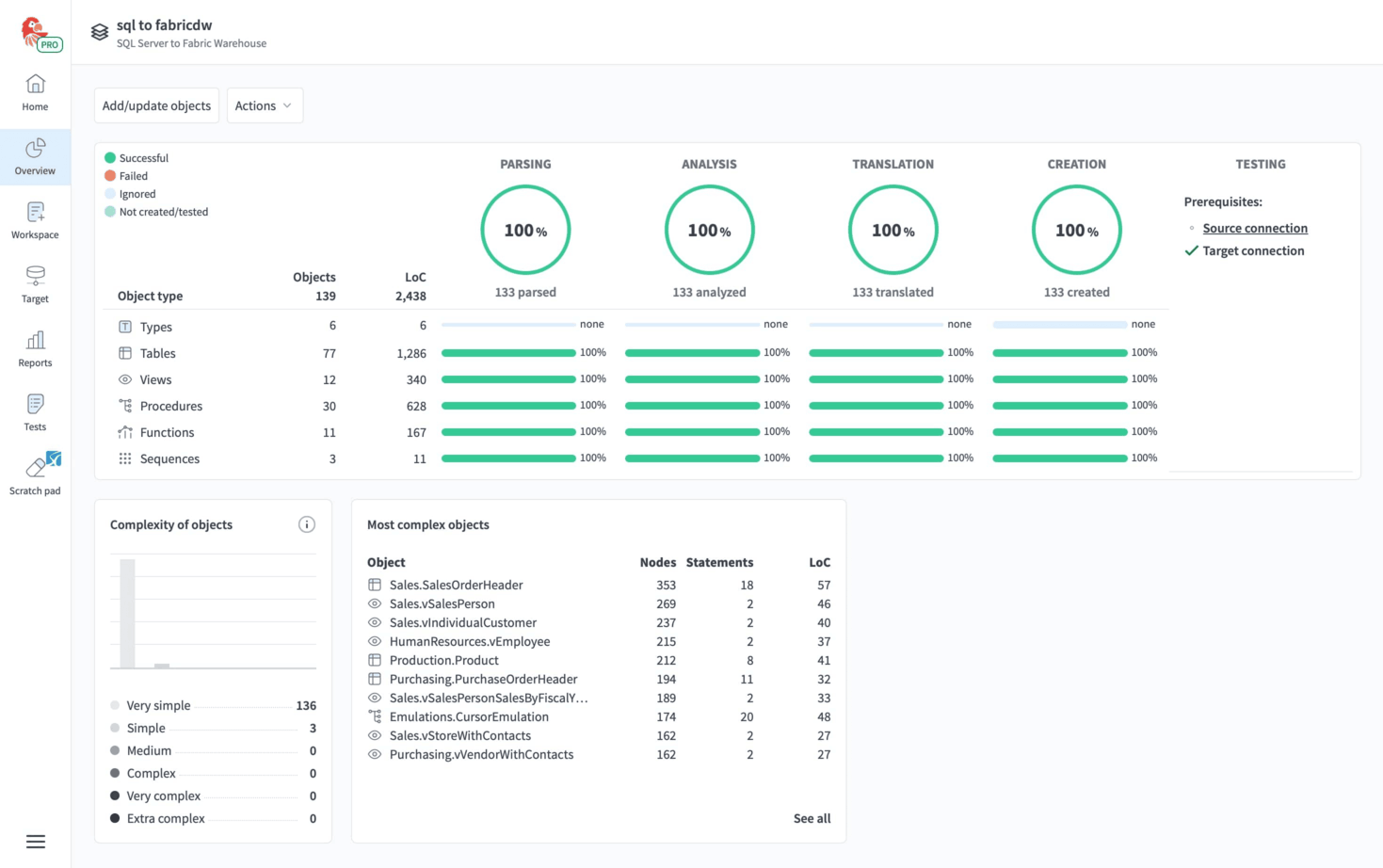
Assessment is instant and detailed. SQL Tran produces a complete translation report showing:
Know exactly how many objects of each type you have.
See how complex your objects are, and how that complexity is distributed across your database.
Know exactly which features are not supported and need manual intervention.
Sophisticated testing framework gives you confidence that your translated database will work as expected.
Automated Testing
Deep static analysis allows SQL Tran to generate comprehensive tests automatically, even from just SQL scripts. These tests validate that your translated database behaves identically to the source, giving you confidence and peace of mind.
SQL Tran’s powerful testing framework is the ultimate project enabler, even when you only have SQL scripts:
- Validate that functions return equivalent results
- Verify that procedures affect tables identically
- Generate synthetic test data tailored to source and target schemas
- Detect edge-case and emulation differences automatically
Migrations available now
These are the source-to-target combinations exposed by the current SQL Tran project wizard. Start an assessment for your database and version to see what SQL Tran can translate, emulate, test, and flag for review. Preview paths are marked explicitly.
Oracle to PostgreSQL
Translate Oracle schemas and PL/SQL into PostgreSQL, then generate tests that compare source and target behavior.
Explore the scenario →Oracle to Fabric Warehouse
Move Oracle database code toward Microsoft Fabric Warehouse with semantic translation and explicit limitation reporting.
Explore the scenario →Oracle to Fabric Lakehouse
Split an Oracle workload into Spark SQL for relational objects and Python/PySpark for procedural code in Fabric Lakehouse.
Explore the scenario →Oracle to Databricks
Split an Oracle workload into Spark SQL for data objects and Python/PySpark for procedural logic on Databricks.
Explore the scenario →Oracle to Google Cloud Spanner
Translate Oracle schemas to GoogleSQL and move procedural logic into a selectable application language for Spanner.
Explore the scenario →SQL Server to Fabric Warehouse
Translate SQL Server schema and T-SQL into the Microsoft Fabric Warehouse dialect, with target limitations surfaced during assessment.
Explore the scenario →SQL Server to Azure Synapse Analytics
Refactor SQL Server schema and T-SQL for the Azure Synapse dedicated SQL pool surface.
Explore the scenario →SQL Server to PostgreSQL
Translate SQL Server schema and T-SQL into PostgreSQL and PL/pgSQL, with differences surfaced before deployment.
Explore the scenario →Azure SQL Database to Fabric Warehouse
Modernize Azure SQL Database code for Fabric Warehouse while keeping the migration inside the Microsoft data platform.
Explore the scenario →Azure SQL Database to Azure Synapse Analytics
Refactor Azure SQL Database workloads for an Azure Synapse dedicated SQL pool.
Explore the scenario →Azure SQL Database to PostgreSQL
Translate Azure SQL Database schema and T-SQL into PostgreSQL and PL/pgSQL.
Explore the scenario →Azure Synapse Analytics to Fabric Warehouse
Move a Synapse dedicated SQL pool to Fabric Warehouse with focused compatibility analysis and T-SQL refactoring.
Explore the scenario →Get SQL Tran today!
Ready to get started?