What changes for you
If range discovery cannot create reliable boundaries, Omni Loader warns and falls back to one unsliced work item instead of inventing unsafe predicates.
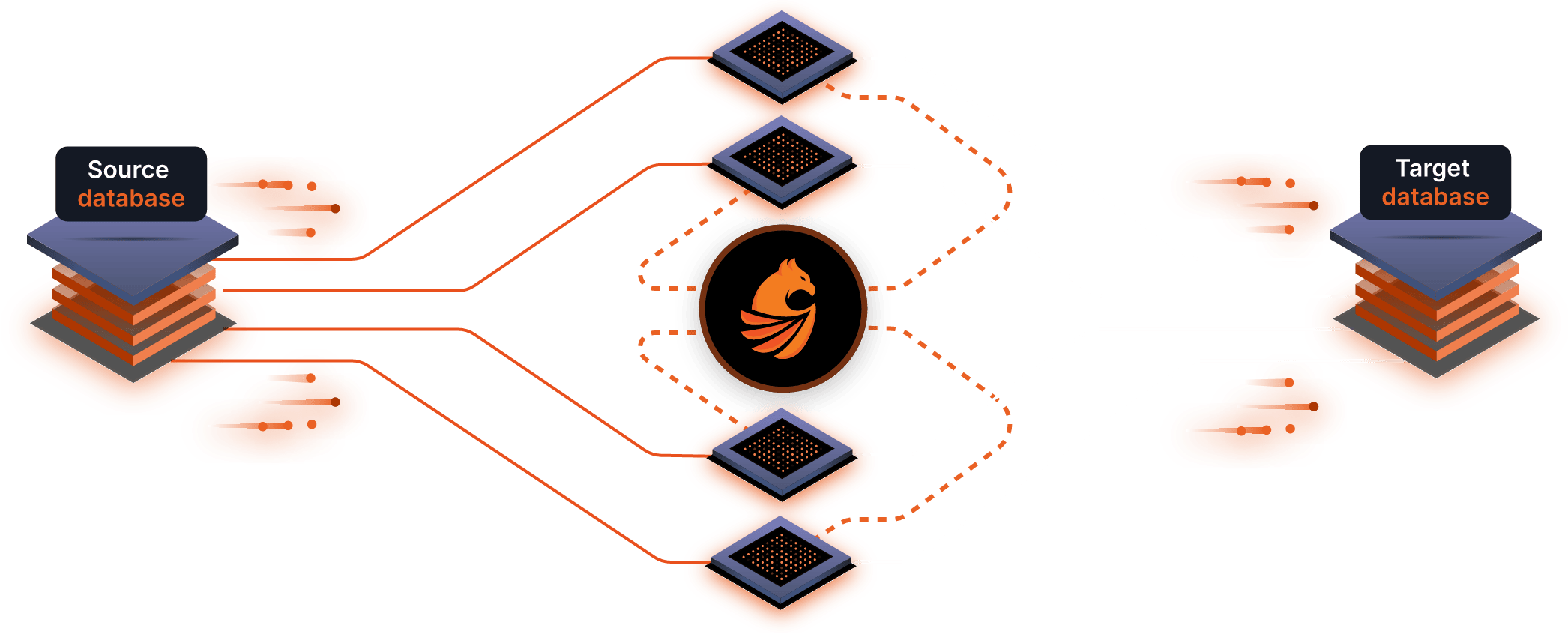
Omni Loader divides large tables into independent slices using source partitions or discovered ranges, then schedules the biggest work first to keep workers productive.
The job to be done
A large migration is not finished when the first rows arrive. Omni Loader keeps parallel work productive, adapts the loading path to the target, and records enough progress to recover the part that failed.
Create slices from native source partitions, numeric ranges, dates and times, text prefixes, an explicit slice column, or file row ranges.
Why this path matters
Create slices from native source partitions, numeric ranges, dates and times, text prefixes, an explicit slice column, or file row ranges.
What changes for you
If range discovery cannot create reliable boundaries, Omni Loader warns and falls back to one unsliced work item instead of inventing unsafe predicates.
The outcome
We will identify usable slice keys, source pressure, worker limits, and the target ingestion budget.
The payoff
Set the concurrency budget for the migration environment.
Break exceptional tables into manageable ranges.
Keep workers occupied instead of leaving the hardest table until last.
Where the work happens
Read each capability as part of the operating path. The important question is not whether a feature exists, but what work it removes and what evidence it leaves behind.
At a glance
Source/target workers and ingestion workers have separate controls so staged cloud loads can be tuned around both extraction and target ingestion.

Multiple slicing strategies
Create slices from native source partitions, numeric ranges, dates and times, text prefixes, an explicit slice column, or file row ranges.
Safe fallback
If range discovery cannot create reliable boundaries, Omni Loader warns and falls back to one unsliced work item instead of inventing unsafe predicates.
Separate ingestion capacity
Source/target workers and ingestion workers have separate controls so staged cloud loads can be tuned around both extraction and target ingestion.
Before you choose
Use the page-specific details below as a short discovery checklist. They are the conditions and work areas that shape the capability, not generic product promises.
The path to confidence
The page keeps the product detail close to the decision it supports. Your team can see what the software handles automatically, what it changes for the target, and what the result leaves ready to operate.
Create slices from native source partitions, numeric ranges, dates and times, text prefixes, an explicit slice column, or file row ranges.
If range discovery cannot create reliable boundaries, Omni Loader warns and falls back to one unsliced work item instead of inventing unsafe predicates.
Source/target workers and ingestion workers have separate controls so staged cloud loads can be tuned around both extraction and target ingestion.
Keep the plan connected
A capability becomes easier to operate when the next decision follows from the constraint you just uncovered. Explore the related work that completes this part of the path.
Your working set
Take the next step
We will identify usable slice keys, source pressure, worker limits, and the target ingestion budget.
Plan my migration