Emulation scenarios
Unsupported system features
Emulation context
In Microsoft SQL Server, system objects such as built-in stored procedures, system catalog views, user and login commands, and DBCC utilities are frequently used for diagnostics, metadata inspection, and server-level configuration. These include objects like:
sp_addrolemember,sp_showspaceused,sp_set_firewall_rulesys.sequences,sys.dm_*viewsCREATE USER,ALTER DATABASE, andDBCCcommands
However, Microsoft Fabric Warehouse supports only a limited subset of system-level operations and configuration objects, excluding many features commonly used for administration and diagnostics. Fabric does not allow direct manipulation of roles, users, database configuration, or extended diagnostics using T-SQL. These system features must be removed or restructured during migration.
Emulation strategy
SQL Tran does not emulate or rewrite system-level constructs. Instead:
- For traceability purposes, unsupported system commands and procedures are commented out using:
/* SQLTRAN FIX: ... */ - Certain T-SQL features and constructs are flagged using diagnostic comments such as:
-- SQLTRAN FABRIC LIMITATION: - No transformation or replacement logic is generated for these constructs, as there is no equivalent in Fabric's SQL surface.
- SQL Tran preserves the original structure to allow downstream review and manual rewriting.
Code example
SQL Server:
CREATE PROCEDURE [dbo].[GetPromotedPeople]
AS
BEGIN
	SET TRANSACTION ISOLATION LEVEL READ COMMITTED;

	SELECT BusinessEntityID, FirstName, LastName, EmailPromotion
	FROM Person.Person
	WHERE EmailPromotion > 0
	ORDER BY EmailPromotion DESC;
END;
Fabric Warehouse (generated by SQL Tran):
-- SQLTRAN FABRIC LIMITATION: -- SET TRANSACTION ISOLATION LEVEL
CREATE PROCEDURE [dbo].[GetPromotedPeople]
AS
BEGIN
	SET TRANSACTION ISOLATION LEVEL READ COMMITTED;

	SELECT BusinessEntityID, FirstName, LastName, EmailPromotion
	FROM Person.Person
	WHERE EmailPromotion > 0
	ORDER BY EmailPromotion DESC;
END;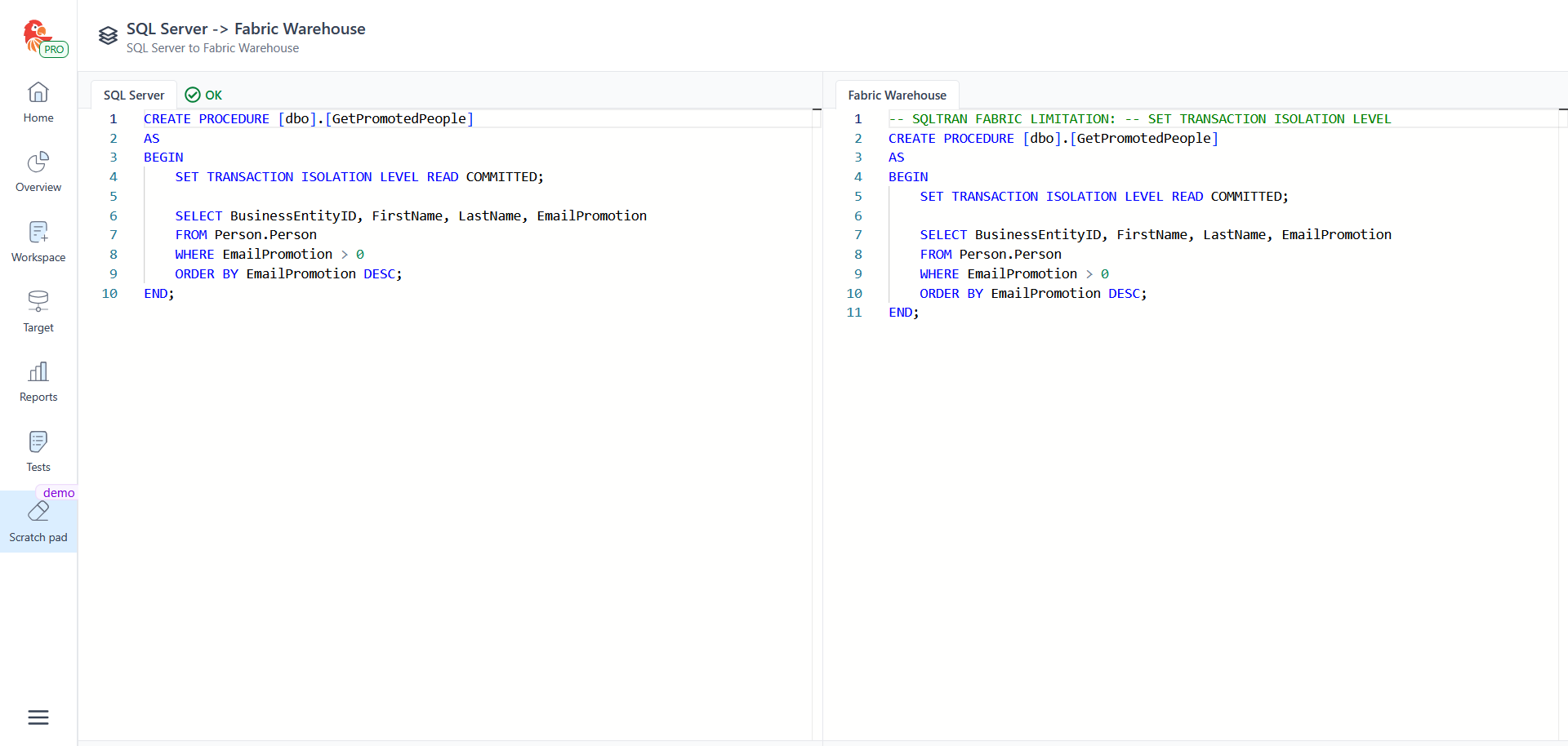
Important notes
- System procedures are not supported:
SQL Server built-in procedures such as
sp_addrolemember,sp_helpuser,sp_set_firewall_rule, andsp_showspaceusedare not available in Fabric and are commented out by SQL Tran. - DBCC and administrative commands are removed:
DBCC statements like
CHECKDB,USEROPTIONS, and platform-level commands such asCREATE USERorALTER DATABASEare not supported in Fabric and are commented out. - System views are selectively supported:
While many system catalog views like
sys.sequencesare not available in Fabric, others likesys.objectsare accessible. SQL Tran only flags unsupported views. - XML methods are flagged:
Unsupported XML methods such as
.value()are identified and annotated by SQL Tran using diagnostic comments. These are not supported in Fabric’s SQL engine. - Unsupported system clauses and special constructs:
SQL Tran flags T-SQL clauses and constructs that are not classified as system objects but are unsupported in Fabric, including:
$PARTITION,FOR JSON,FOR XML,FOR BROWSE, and recursive common table expressions (CTEs). These are preserved in the translated output but must be manually replaced or removed. - Full-text search not supported:
Microsoft Fabric does not support SQL Server full-text search features such as
FREETEXTTABLE,CONTAINSTABLE,FREETEXT, orCONTAINS. These rely on full-text indexes, catalogs, and semantic search infrastructure, none of which exist in Fabric. SQL Tran retains these statements and flags them with a-- SQLTRAN FABRIC LIMITATION: -- FULL-TEXT SEARCHcomment, but does not rewrite or emulate their behavior. Any full-text search logic must be manually removed or reimplemented using Fabric-supported techniques, such asLIKE,CHARINDEX, or preprocessed keyword filtering. - Identity functions unsupported:
Fabric does not support identity-tracking functions such as
@@IDENTITY,SCOPE_IDENTITY(), orIDENT_CURRENT(). These functions depend on identity columns and engine-level metadata that are not available in Fabric’s distributed environment. SQL Tran preserves these statements in the translated output but flags them with a-- SQLTRAN FABRIC LIMITATION:comment. Any logic that depends on retrieving identity values must be manually reworked using Fabric-compatible alternatives such asNEWID(),ROW_NUMBER(), or custom sequencing strategies based on sequences or output parameters. - No emulation or fallback is generated: SQL Tran does not attempt to simulate or replace unsupported system objects or features. All such usage must be manually reviewed.
- Manual review required: Any logic that depends on system-level behavior, metadata access, or administrative commands must be reviewed and rewritten using Fabric-compatible ingestion tools, platform APIs, or equivalent logic external to the warehouse SQL surface.